
Ants
A reality of jungle life

Greetings! Trying to catch up so I can start writing about where we are now- we just started a Mayan ruins tour and we’ll be running around Quintana Roo, Belize, and Guatemala for the next couple weeks. So stay tuned for that! Today, before we venture out for breakfast, here’s what’s been going on at home with the ants.
6/18/26
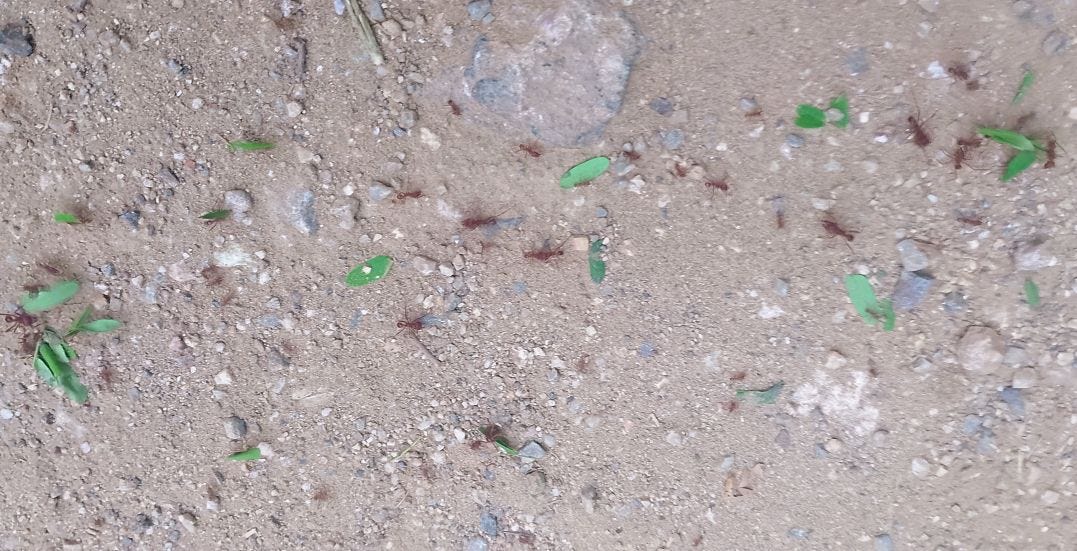
In Mexico, we have many kinds of ants. There are the little tiny ants that you can barely see that get in your sugar. There are the owwwwie kind (not the scientific name) that bite you while you’re hiking. Then there are the chicatanas, winged ants that swarm in front of your porch lights on the first day of rainy season and leave their wings all over your patio. But today I will discuss the bane of jardineros all over south and central Mexico- the leaf-cutter ant, Atta mexicana.
(Note: as I was doing research for this article, I learned that Atta mexicana and chicatana are in fact the same ant, so I’ll be using both names interchangeably).
The first time I saw the long line of ants, busily carrying their bits of leaves and flowers, I was fascinated. Ants are cool, and leaf-cutter ants are super cool to watch. I quickly learned they did not behave like the army ants in the 1954 movie The Naked Jungle (link below if you are not familiar with this Charlton Heston film). Those ants decimated everything in their path, including humans, and terrified me as a kid. However, a quick Google search assured me that I had nothing to worry about. Chicatana are pickier. They won’t devour humans – though their bite is pretty painful, so keep a respectful distance. Nor can they denude an entire forest. They do cut an estimated 10-15% of leaves within its foraging range, and unfortunately for gardeners they love roses and hibiscus. It is a sad and shocking sight to go into your garden and find your formerly lush green plants reduced to naked twigs overnight. My mom declares war whenever she sees an ant trail, following it with a flashlight (they tend to forage at night) and leaving poison near the nest opening whenever she finds it.
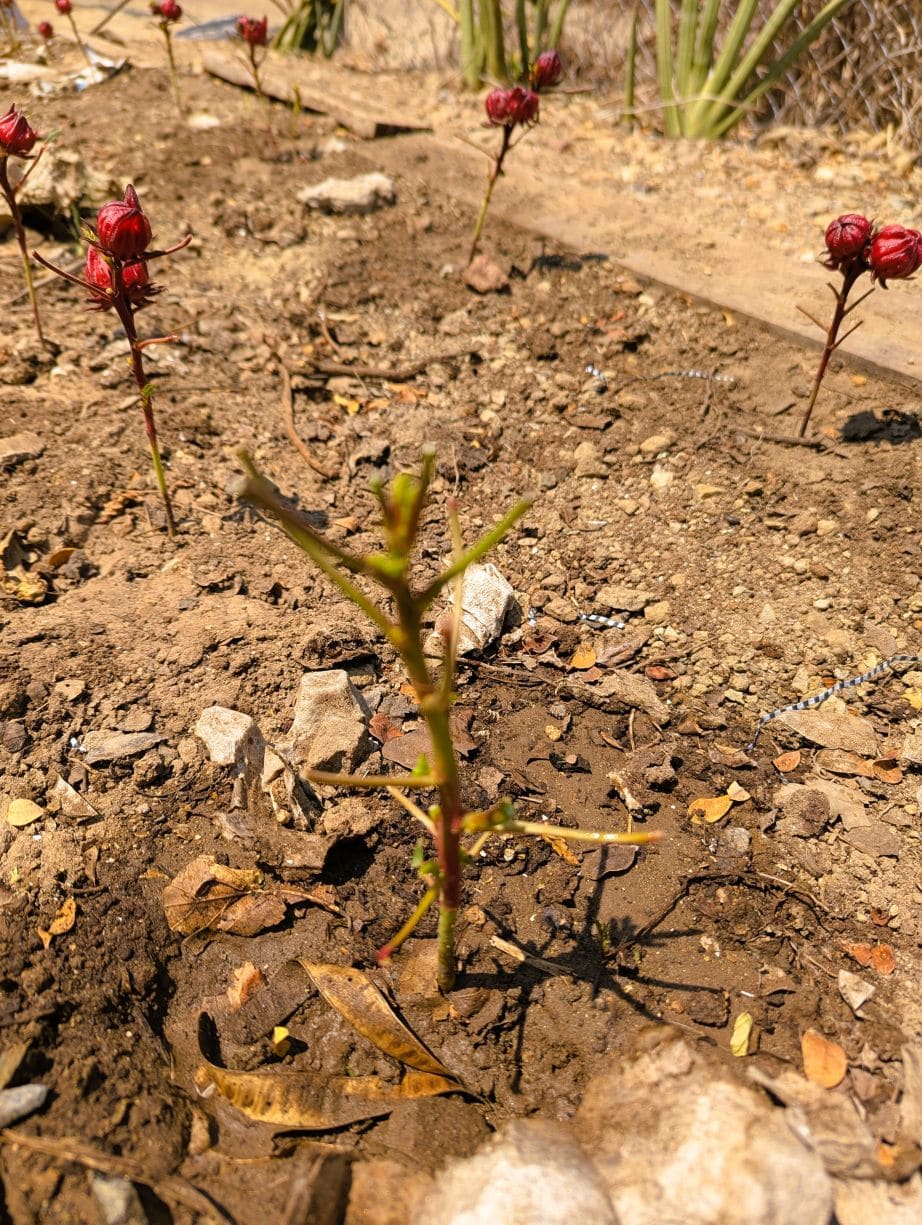
I still find the ants interesting, and I would prefer not to murder them, but I also want to save my jamaica (hibiscus) and my maracuya (passion fruit). Is there any way to peacefully co-exist? Dear readers, here is what I’ve learned about chicatanas so far:
They are farmers. Chicatana take the cut leaf bits underground, and use them to feed a specific type of fungus called Leucogaricus gongylophorus. This fungus is cultivated as a food source for the entire colony.
Colonies are huge. A three-year old adult leaf cutter ants’ nest can house up to five million ants, cover an area of a hundred square meters, and consume a ton of vegetation per year.
The plants can come back. The first time the jamaica lost their leaves, I thought they were done for and pulled up the naked stalks. The second crop I left alone and continued to water them. Slowly, the leaves returned. However, they have recently been hit again and I’m not sure they can keep this cycle up. Maracuya grows like a weed and I’m holding out hope that my little vine will fill out again. However, I think I need to try something else to help them.
Chicatana ants are apparently a delicacy! Like, people can’t wait for the first week of rainy season when they can harvest these ants and use them in tacos, salsas, and moles. This seems to be more of a thing in Chiapas and Oaxaca, which does not surprise me as Oaxacans will eat all kinds of different bugs. I do not see any restaurants in Jalisco or Nayarit offering up chicatana tacos, but maybe I’m not looking in the right places?
I am not against trying chicatana as a snack, but I don’t think Lurko and I could make a dent in a colony of millions. Ideally, I’d like to know how to peacefully co-exist with my insectoid neighbors. Are there other types of plants they like, and can I encourage them to eat those and not my jamaica? (Edit: now that rainy season has begun, they have been feasting on closer more convenient plants, so yay.)
Also, I am learning more about soil, and wondering how that plays a part. I recently had to fill in some low spots in my land, so Jorge’s guys brought in a bunch of fill dirt from his property. It did the job, but it is mostly rocks and sand, not conducive to growing anything outside of cacti and succulents. I have built some beds and added compost, and a couple of bags of soil trucked in from Talpa, a mountain town in the neighboring state of Jalisco that apparently has very fertile black soil. Rainy season has just begun, and I am amazed by the number of weeds growing, even from the fill dirt. So that tells me, without having to do a bunch of soil tests, that the land is at least somewhat capable of supporting life.
I recently read a Substack article (link below, and shoutout to Ruth who writes about growing cacao in Belize) that reminded me once again about how healthy soil needs to include fungus. I wondered whether the ants would eat the fungus that grows in healthy soil, but they are apparently very picky and only eat Leucogaricus gongylophorus. I should still try to improve my soil, but the greatest soil in the world is not going to keep the ants out of my garden.
Things I have tried so far to deter them:
Cinnamon is known to deter ants, and I accidentally bought a huge bag of ground cinnamon, so I tried sprinkling it around my beds. The verdict: not effective against leaf-cutter ants at all. They completely ignored it.
Mulch can sometimes be a deterrent. I used my mom’s mulch, made from shredded mango leaves, and last week I noticed the ants harvested the unmulched bed but left the mulched bed alone. Perhaps they chose the path of least resistance? They’re supposed to be pretty smart.
I called Misael, our friend and pest control professional. He is currently trying a pelleted insecticide (abamectin) that is supposed to work against leaf-cutter ants without endangering the dog or other animals. We sprinkled pellets a couple of weeks ago, and the jury is still out on whether this is effective.
Other things the Internet has told me:
The ants cannot climb on smooth surfaces, so when I have trees that I want to protect, I can make a skirt with a plastic soda bottle. I may try making a little plastic barrier around the maracuya vine.
Another protection for trees is painting the trunks with calcium carbonate. This is a popular method in Mexico; you often will see the bottom parts of tree trunks painted white in public parks.
Find the nest and pour boiling water in it. This works for fire ant mounds in Texas.
They apparently do not like the castor oil plant (Ricinus communis), and you can make a poison by soaking the leaves and seeds for a day in water and spraying it on the ants. Castor does grow like a weed here and it’s easy to identify. I’ve wondered if I should encourage it to grow around the fenceline, but knowing that the plant is also poisonous to humans and dogs, maybe this is not a great idea.
If the insecticide does not work, we might want to consider a fungicide. The idea is: destroy the fungus (their source of food), and the colony would fall apart.
I’ve been checking on my poor denuded stalks every day. A few jamaica are just dry twigs and I’ve had to pull those. The majority of them do have new leaves, so that is hopeful. Last week I saw the chicatana cutting in another part of the yard that’s only weeds, so I was hoping they’d stay there, but then a couple nights ago they went after the brand-new jamaica seedlings. Arrrrrgh. However, they left the other bed alone. Path of least resistance? I may try adding mulch and maybe that will make it harder for the ants to reach it.
It sounds a little bleak right now, but fear not! I have a lot more jamaica seeds. And I’ll keep trying, ‘cause damn it, I really love jamaica jam.
Sources:
Atta mexicana, https://en.wikipedia.org/wiki/Atta_mexicana. Retrieved June 19, 2026.
Beyond Rainbows and Unicorns, by Ruth Moloney.

. Retrieved June 18, 2026.
Leaf cutter ants-Boca del Toro Island- Panama https://conversations.echocommunity.org/t/leaf-cutter-ants-boca-del-toro-island-panama/1337/2 Retreived June 19, 2026
Leucocoprinus gonglyophorus, https://en.wikipedia.org/wiki/Leucocoprinus_gongylophorus. Retrieved June 19, 2026.
Organic Remedies for Crawling Leaf Cutters | Ants
Retrieved June 19, 2026.
Reversing the game: plants against the sauba ant. Retrieved from https://revistapesquisa.fapesp.br/en/reversing-the-game-plants-against-the-sauba-ant/ on 06/19/26
The Naked Jungle, https://en.wikipedia.org/wiki/The_Naked_Jungle#:~:text=Telling%20the%20story%20of%20an,the%20Ants%22%20by%20Carl%20Stephenson. Retrieved June 19, 2026.
************************
This blog will always be free, but if you liked this article, here’s all the ways you can support Julie and Lurko in Mexico and keep it ad-free:
However you choose to participate, your support makes my day and helps others find us. Thank you!
*****************
It's funny that when I was a kid I had many ant farms, in fact the basement of our house was largely an ant zoo. I tried for years to get a leaf cutter ant colony to be successful. Now, in Mexico I mostly want to burn them with fire!
They do like the Hibiscus which in Yucatan we call Tulipanes (translated as tulips) not to be confused with Tulipanes Hollandesas (actual Tulips). When we first came to Mexico we had a vibrant, beautiful hibiscus full of life and the next morning a bunch of bare sticks. It was a potted plant so we moved it once a week to keep the ants confused which worked as we didn't know what else to do.
Now that we've been here for quite some time we're a bit better at managing our environment. Abamectina (Trompa) does work but it's a maintenance thing, not a one-and-done thing. Buy a big bag and just leave it around your yard every week or two forever. It keeps them at bay. We have hibiscus plants sitting right in the middle of the patio that never get touched anymore. Also have plenty of other plants that they like helps. We have a couple of vines that are massive covering our back wall and they chomp away on them forever and the vines are so massive they just replenish. We also have quite a few maracuya but oddly they've never cared about them. The maracuya when they're young get caterpillars but by the time they're about 3-4 meters long the caterpillars disappear and we never see them again until we start a new plant.
The leaf cutter ants are slightly adorable though. We often get into the pool at night and the long line of leaf cutters walking the perimeter with leaves in their jaws look like a million little sailboats out to sea. They remind me to cherish every moment of life... and put out more Trompa. ;-)
Fascinating! I first saw leaf-cutters in Costa Rica. I had no idea how lucky I am that I live in a place without the little buggers. All the best in your pest control.